Opis
The authors of this book represent a multinational group which is interested in studying the activities of foreign investors in implementing their respective corporate social responsibility programmes in developing host countries at three levels: local, regional and national. At present, CSR is one of the essential „products” accompanying nearly any investment activity. This is why foreign investors, equipped with modern tools, should aim to take the lead in this process.
The concept of CSR in the management sciences is often misunderstood because it is usually seen as one of the means employed in the challenge of achieving a better competitive position. On the other hand, for the development sciences CSR is an effective instrument for income redistribution and serves as an additional support for unprivileged social groups.
The authors seek to verify the main hypothesis formulated for the purposes of the monograph, that the readiness of multinational corporations to serve local communities depends on the maturity of the national and local legal framework. The more developed the country is in terms of its legal standards, the more the local community tends to benefit from CSR. On the contrary, in poor countries with weak institutions, multinational companies are not obliged to respect the needs and desires of the local population. It will be interesting to find out if this hypothesis has been positively verified.
From the review
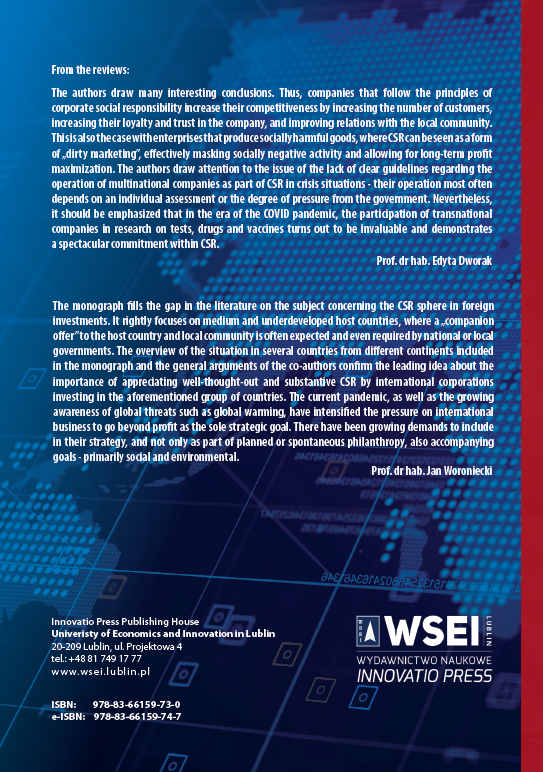
The authors draw many interesting conclusions. Thus, companies that follow the principles of corporate social responsibility increase their competitiveness by increasing the number of customers, increasing their loyalty and trust in the company, and improving relations with the local community. This is also the case with enterprises that produce socially harmful goods, where CSR can be seen as a form of „dirty marketing”, effectively masking socially negative activity and allowing for long-term profit maximization. The authors draw attention to the issue of the lack of clear guidelines regarding the operation of multinational companies as part of CSR in crisis situations – their operation most often depends on an individual assessment or the degree of pressure from the government. Nevertheless, it should be emphasized that in the era of the COVID pandemic, the participation of transnational companies in research on tests, drugs and vaccines turns out to be invaluable and demonstrates a spectacular commitment within CSR.
Prof. dr hab. Edyta Dworak
The monograph fills the gap in the literature on the subject concerning the CSR sphere in foreign investments. It rightly focuses on medium and underdeveloped host countries, where a „companion offer” to the host country and local community is often expected and even required by national or local governments. The overview of the situation in several countries from different continents included in the monograph and the general arguments of the co-authors confirm the leading idea about the importance of appreciating well-thought-out and substantive CSR by international corporations investing in the aforementioned group of countries. The current pandemic, as well as the growing awareness of global threats such as global warming, have intensified the pressure on international business to go beyond profit as the sole strategic goal. There have been growing demands to include in their strategy, and not only as part of planned or spontaneous philanthropy, also accompanying goals – primarily social and environmental.
Prof. dr hab. Jan Woroniecki